
Madison County Court Records After a Jail Arrest
After an arrest in Madison County, custody usually runs through the Madison County Detention Facility at 815 Wheeler Ave NW in Huntsville. The arresting agency may be the Madison County Sheriff's Office, Huntsville Police Department, Madison Police Department, ALEA, a court, or another local authority. Booking creates the jail entry, including booking number, booking time, charge summary, bond amount, holds, and arresting agency. Formal court records are separate. They are maintained by the Madison County Circuit Clerk for District and Circuit Court proceedings, or by the relevant municipal court for city ordinance, traffic, and municipal misdemeanor matters.
The arrest-to-court pathway can take time. The jail-information material notes that an arresting agency may need to obtain felony warrants through the Madison County Magistrate Office, a process that may take up to 48 hours. Once the warrant or contract is received, a District Court inmate may receive a 72-hour hearing to be notified of charges and bond. That means a roster charge can be useful for immediate intake context, but court records after an arrest should be checked through the clerk or Alacourt before treating the charge list as final.
Three records often matter in the same case. The jail booking record shows custody, bond, holds, and preliminary charge information. A police incident or arrest report may contain narrative details if the arresting agency can release it under Alabama law. The court case file shows formal charges, case action summary, settings, rulings, party information, costs, and documents when available. For the custody side, use jail inmate records; for booking photos, use jail mugshots.
How to Find Madison County Court Records After an Arrest
For state-law cases in Madison County, the local Circuit Clerk is the official record keeper for District and Circuit Court proceedings. Debra Kizer's Circuit Clerk office is listed at 100 Northside Square, Room 217, Huntsville, AL 35801, with phone 256-532-3390. The clerk points users to Alabama's trial-court record system, commonly reached through Alacourt or Just One Look, for electronically imaged court information. Older files, certified copies, or mail and in-person routes may require the clerk's records request form.
- Start with the official Alacourt ACCESS portal when the case is a Madison County District or Circuit Court matter.
- Search by defendant name or case number. A name search is useful when the jail roster shows only a booking number or charge summary.
- Open the case detail and compare the court charge list with the jail roster charge description, arresting agency, and court type.
- Read each charge row for status, court setting dates, rulings, costs, and available document images.
- Use the Madison County Circuit Clerk records request route for copies, certified records, or records not handled through the online transaction flow.
Municipal cases have different owners. Huntsville municipal matters should be routed to Huntsville Municipal Court or the Huntsville Magistrate. City of Madison Municipal Court handles city-limit misdemeanor offenses, traffic tickets, pending cases, records, and warrants at 100 Hughes Rd, Madison, AL 35758, phone 256-772-5617. Federal cases are not supplied by the Madison County Circuit Clerk request form; those records belong in the federal court system, with custody questions often routed through the U.S. Marshals Service or BOP depending on case stage.
The captured Alacourt ACCESS home screen shows the paid search structure for Alabama trial-court records.
Alacourt ACCESS displays criminal and civil case access options, including name searches, case-number searches, document images, and monitoring fees.
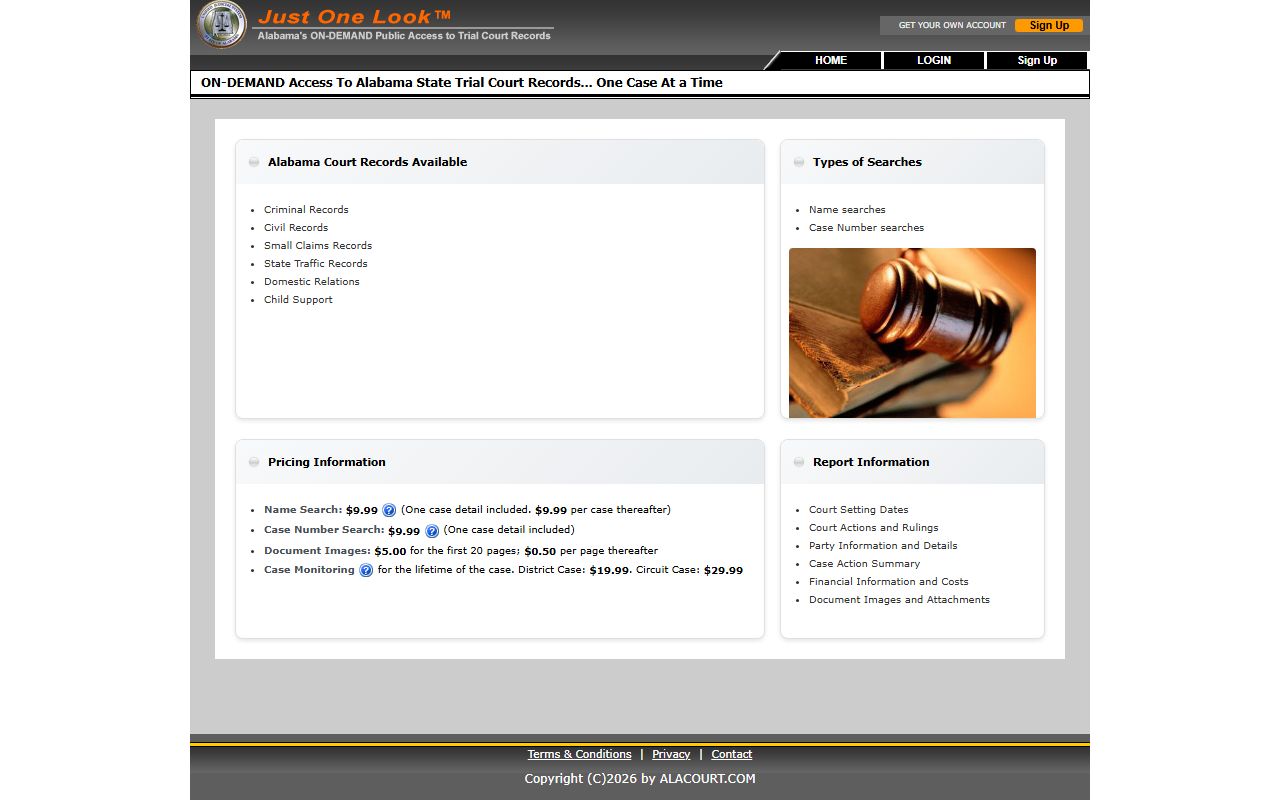
That portal is the court-record channel, not the Madison County jail roster, so it is the better source once a charge has moved into a formal court case.
| Alacourt Field or Option | Type | Use Notes |
|---|---|---|
| Name Search | Paid search mode | Listed at $9.99 with one case detail included; a no-match result still counts as a search. |
| Case Number Search | Paid search mode | Listed at $9.99 with one case detail included; best when a clerk, warrant, or roster detail already provides a case number. |
| Document Images | Purchase option | Listed at $5.00 for the first 20 pages and $0.50 per page after that when images are available. |
| Case Monitoring | Notification purchase | Listed at $19.99 for District Court and $29.99 for Circuit Court, with email notifications for later changes. |
| Login or Sign Up | Account control | Use beyond the landing page is gated by the portal's transaction and account flow. |
How Charges Get Filed After an Arrest
The court record begins when a charging document or court filing puts the accusation into a case. A booking charge can come from the arresting officer, warrant, hold, or court commitment. Prosecutors may then file, amend, reduce, or decline charges. The Madison County District Attorney's Office, led by Robert L. Broussard for the 23rd Judicial Circuit of Alabama, prosecutes state-law criminal cases after arrest. The DA office is at 100 North Side Square, Huntsville, AL 35801, phone 256-532-3460, and is not a public case-search portal.
| Document | Who Uses It | Common Role After Arrest |
|---|---|---|
| Complaint | Officer, magistrate, or prosecutor depending on case type | Often starts lower-court criminal matters and helps move an arrest into a court case. |
| Information | Prosecutor | A formal accusation used when a defendant proceeds without indictment in certain felony contexts; sheriff material tells inmates seeking plea by information to contact counsel. |
| Indictment | Grand jury | A felony charging document returned by a grand jury and filed in court. |
| Warrant or Commitment | Court or magistrate | May explain why a person was booked on an alias warrant, certified copy, probation revocation, or back-for-court hold. |
Charge Status in Court Records After an Arrest
Charge status can change after the booking record appears. The sheriff roster warns that charges and bail amounts may change after court appearances and may not be current. The court file is where later action should be checked, especially when a charge has been amended, reduced, dismissed, closed, or left active. On the jail profile, court values such as MUNI, DIST, and CIRC help route the reader to municipal court, District Court, or Circuit Court.
| Status | What It Means | Where to Verify |
|---|---|---|
| Pending or active | The charge or case has not reached final disposition. | Alacourt, Circuit Clerk, or the owning municipal court. |
| Amended or reduced | The prosecutor or court changed the charge from the original booking description. | Court case action summary and charge rows. |
| Dismissed | The court record shows the charge was dismissed, often after a filing, hearing, plea arrangement, or other case action. | Court order or disposition entry. |
| Nolle prosequi | The prosecutor chose not to pursue that charge at that stage. | Court docket or prosecutor-filed entry. |
| Convicted | A final guilty verdict, plea, or adjudication was entered. | Disposition, sentencing entry, and case action summary. |
Bond and Release After an Arrest
Bond information on the Madison County roster is a snapshot, not a guarantee. The jail page directs bond companies and anyone posting bail to call detention center staff at 256-519-4800 for correct bail amount, charges, and case numbers. Huntsville city misdemeanor bonds are handled through the City of Huntsville magistrate 24 hours a day at 256-427-7817. City of Madison municipal bonds are handled through Madison Municipal Court during business hours at 256-772-5617, with online cash bond options noted by the city. Madison County misdemeanor and felony bonds are handled through the District Court Clerk's Office at the courthouse, Room 200, Monday through Friday 8:00 a.m. to 3:30 p.m., excluding holidays, phone 256-532-3373.
| Bond Type | How It Works in Madison County Context |
|---|---|
| Cash Bond | Paid through the court, authorized online vendor, or court-specific payment channel when available. |
| Surety Bond | Posted through a local bonding company; the company should confirm current charges and amounts with detention staff. |
| Property Bond | The sheriff states that MCSO does not process property bonds within or outside Madison County. |
| No-Bond Hold | The roster may show NO BOND, NONE, or $0.00, and another hold or detainer may prevent release until court action. |
Warrants That Lead to an Arrest and Court Record
No standalone Madison County Sheriff's Office active-warrant search form was located. The sheriff site has a Most Wanted route and lists Warrants / Extraditions fax 256-533-5642, while the county court system includes warrant magistrate routes. City of Madison gives the clearest municipal warrant process: the incident must have occurred inside Madison city limits, the offender must be over 18, an incident report must be filed with Madison Police, and the complainant should call the Court Clerk's office at 256-772-5617 before a sworn hearing. Once a warrant is served and a person is booked, the jail roster may show descriptions such as alias warrant, alias writ arrest, certified copy, failure to appear, or violation of probation.
Charges vs. Convictions
An arrest and a charge are accusations, not proof of guilt. Madison County court records after an arrest may show allegations that are still pending, later amended, dismissed, or resolved. A conviction is different because it reflects a final guilty plea, verdict, or adjudication entered by the court.
| Point of Comparison | Charge | Conviction |
|---|---|---|
| Stage | Accusation after arrest or filing | Final case outcome by plea, verdict, or adjudication |
| Proof Level | Based on probable cause, warrant, or charging decision | Requires the criminal-case burden and a final court action |
| Roster Effect | May appear quickly as a booking or hold description | May affect sentence, transfer to ADOC, or court costs |
| Record Check | Verify in the court file before relying on it | Verify sentencing and disposition entries |
Sealed vs. Expunged Arrest Records
Alabama public-access law starts with a broad right for residents to inspect and copy public records under Alabama Code § 36-12-40, but exceptions matter. Alabama Code § 12-21-3.1 protects law-enforcement investigative reports and related material from ordinary disclosure. Expungement is controlled by Alabama Code Title 15 Chapter 27, and ALEA explains that Alabama courts grant expungements, not ALEA. A dismissal or acquittal does not automatically erase every public trace without the required court process.
| Point of Comparison | Sealed | Expunged |
|---|---|---|
| Public Visibility | Restricted from ordinary public access. | Removed from ordinary public access under a qualifying court order. |
| Record Holder | Court or agency keeps the record but limits access. | Court directs qualifying records in court or law-enforcement custody to be expunged, subject to statutory exceptions. |
| Criminal Justice Access | May remain available to authorized agencies. | Forwarded to ALEA for protected archive treatment and national repository withdrawal requests when required. |
| Best Local Route | Ask the court or clerk about the status of the record. | Follow Alabama court expungement procedure and obtain required certified records before filing. |
Background Check Considerations
Casual court record lookup is not the same as a legally compliant employment, credit, insurance, housing, or tenant-screening background check. When a record could affect a formal eligibility decision, use a compliant consumer-reporting process and verify the outcome with the originating court or agency.
Important: Madison County Inmate Population is not a consumer reporting agency under the FCRA, and information here may not be used for FCRA-covered decisions.
Restricted Court Records After an Arrest in Madison County
Not every arrest-related record is public in the same way. Juvenile and youthful-offender records, sealed matters, expunged records, some dismissed matters, victim-sensitive details, and law-enforcement investigative materials may be withheld or restricted. Police report access also depends on the arresting agency. Huntsville Police records requests can require a valid ID, case number, date or location, reason for the request, and requester eligibility, while Madison Police Services maintains its own records channel for city reports. The most reliable rule is to route the request to the office that owns the record: sheriff for jail custody, police department for incident reports, municipal court for city cases, Circuit Clerk or Alacourt for District and Circuit cases, ADOC for state prisoners, and federal systems for federal custody.